JSD Lab Newsletter – Fall 2025
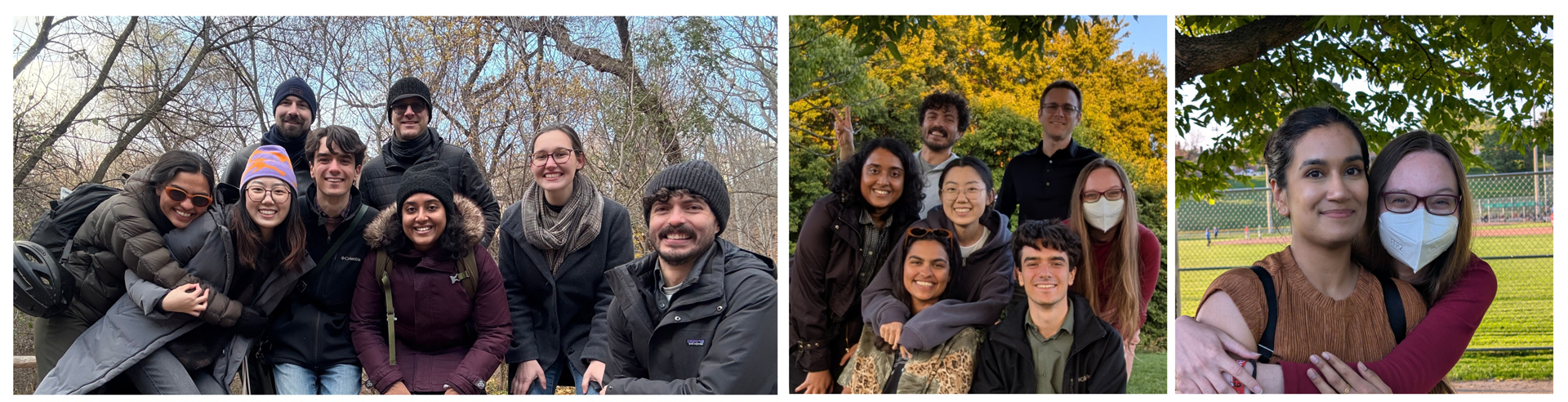
Welcome to the first edition of the JSD Lab newsletter. This year has been full of creative experimentation, collaborative research, and new local and international partnerships. We’re excited to share highlights from our community.
Contents
WELCOME TO THE LAB!
ACHIEVEMENTS AND COLLABORATIONS
PROJECTS
RESEARCH FUNDING
PUBLICATIONS
COMING UP
Subscribe to the JSD Lab Newsletter
Welcome to the Lab!
This fall, the JSD Lab welcomed four graduate students.
Nadia Mariyan Smith is a PhD student in the Faculty of Information at the University of Toronto. With a background in community work, they are interested in justice-oriented, more-than-human design approaches that emphasize collective well-being and ecological sustainability. Nadia holds a Master of Information in User Experience Design and a Bachelor of Fine Arts in Photography.
Nils Bonfils is a PhD student in the Faculty of Information at UofT. After completing his BSc and MSc degrees in Computer Science at EPFL, he worked in the banking and telecom industries as a Software Engineer for a few years. This allowed him to recognize the proportions and unsustainability of modern technological trends. He decided to pursue a PhD to explore and understand alternative ontologies in which information technology practices can be made more sustainable. His research interests span across Information, Computer Science, STS and the Environment. Other subtopics of interest are permacomputing, technology otherwise, convivial computing and digital degrowth.
Rowan O.A. Munson is a PhD student at the Faculty of Information at the University of Toronto. His research interests focus on reconnecting technology to people, place, and planet. He is particularly interested in methods that are participatory, that broaden perspectives beyond WEIRD (Western, Educated, Industrialized, Rich, and Democratic) contexts, and that bridge academic theory and industry practice to create real-world impact. Previously, Rowan managed social research projects for UK Government agencies and charities, and published and lectured in Health and Social Care. He has advocated for policy changes to address social and environmental injustices and continues to engage in advocacy efforts to drive meaningful change. He holds an MSc in Behavioural and Data Science from the University of Warwick, UK; and a BA in Philosophy, Politics, and Economics from the University of Oxford, UK.
Cristian Velasquez is an artist, photographer, and specialist in digital communication strategies and content production. He is currently pursuing a Master of Information at the University of Toronto, where he also leads communications and engagement for both the Just Sustainability Design Lab and the Knowledge Media Design Institute. Cristian’s artistic practice centers on documentation, making marginalized cultural practices and community histories visible. Over the past two years, he has been developing an ongoing visual archive of Toronto’s nightlife and culture. He has previously worked at the University of Toronto Scarborough Library, where he led initiatives to mobilize digital collections. In Colombia, he worked at the Ministry of Culture, contributing to the design and implementation of inclusion and diversity policies, advancing national literacy initiatives, and supporting public education and engagement.
The JSD Lab is happy to host two International Graduate students in 2025.
Victoria Landau investigates how cultural and research institutions approach digital sustainability, preservation, and curation. Her doctoral research at the University of Basel examines how institutional decision-making shapes heritage collections, both analog and digital, and how open standards support long-term access and preservation. We are grateful for the insight and energy she brought to our community. Wishing you continued success on your PhD journey, Victoria!
Verena Müller is a PhD candidate at the Technical University of Munich whose work connects technology, law, and environmental sustainability. After completing her degree in Law, she joined the Professorship for Law, Innovation and Legal Design at TUM as a researcher and doctoral candidate. Her research spans the intersection of technology, society, and regulation. Her current project focuses on AI regulation and environmental sustainability, exploring innovative approaches to integrate law and AI practices to promote “Sustainability by Design.” Verena joins us for Fall 2025 and Winter 2026.
Achievements and Collaborations
“Near Data” and “Far Data” for Urban Sustainability: How Do Community Advocates Envision Data Intermediaries?” received a Best Paper Award at ACM CSCW 2025.
Authored by Han Qiao, Siyi Wu, and Christoph Becker, the winning paper explores how community organizations navigate and negotiate data, ranging from local, lived information (“near data”) to large scale, processed datasets (“far data”). The study uncovers design possibilities for tools that center community expertise in building sustainable urban futures. PhD Candidate Han Qiao, who presented the work, grounds her doctoral research in a deceptively simple question: How do our everyday encounters with data influence the way we imagine—and shape—the cities around us? Her dissertation examines how our interactions with data inform our relationships to physical spaces and our collective imaginaries of urban futures.
This research continues through the School of Cities Urban Challenge Grant (2025–2027), in collaboration with the Visionary Communities team in Scarborough. Together, we are developing practices that make heavily processed (far) data relevant for local knowledge contexts and aspirations, and re-embed community generated knowledges and aspirations (near data) in a far-data context to help municipal decision-makers better recognize, value, and act upon the insights and aspirations of community-based changemakers. Read the full text.
Climate Change: What Is Computing’s Responsibility? Reflections from the Dagstuhl Perspectives Workshop
In March 2025, a group of leading practitioners, policy experts, and researchers — including Christoph Becker — convened at Dagstuhl Leibniz Center for Informatics in Germany on invitation of the ACM to examine a pressing question: What is computing’s responsibility in the current climate crisis? The resulting Dagstuhl Manifesto is a wide-ranging call for a fundamental shift in how computational systems are designed, deployed, and governed.
The Manifesto challenges the assumption that efficiency gains or technological optimism alone can offset the rapidly escalating environmental impacts of digital infrastructures. Instead, it argues for reorienting computing toward sufficiency, long-term durability, human rights, and planetary boundaries. It underscores the need for transparent environmental assessments, a stronger role for computing professionals in shaping digital policy, and a renewed commitment to climate-conscious education and practice. For those working at the intersection of technology, sustainability, and justice, this document offers an essential framework for the years ahead. Read the full text.
Resisting GenAI and Big Tech in Higher Education
On November 25, an international panel of scholar-activists came together to examine the expanding influence of generative AI across universities and the urgent need to push back. From escalating energy and water consumption to disruptions in learning, academic integrity, and governance, the session unpacked the social, environmental, and political risks of AI’s rapid adoption.
Speakers included Christoph Becker (University of Toronto), Mary Finley-Brook (University of Richmond), Dan McQuillan (Goldsmiths, University of London), Sinéad Sheehan (University of Galway), Jennie Stephens (National University of Ireland Maynooth), and Paul Lachapelle (Montana State University). They shared concrete examples of resistance and refusal, offering pathways for collective action and for challenging the narrative that AI’s expansion is inevitable. If you missed the live event, you can now watch the full recording here
From Tech Lash to Tech Fash: Strategic Reflections on a Decade of Collective Organizing in Computing
On August 19, as part of the Aarhus 2025 conference, this workshop brought together seasoned and early-career technologists, practitioners, and scholar-activists to collectively reflect on how the field has shifted over the past decade from what Tamara Kneese has described as “techlash” to “tech fash” (Kneese, 2025). Participants explored how lessons from struggles around misinformation, algorithmic bias, surveillance capitalism, and tech worker organizing might inform contemporary resistance to the growing power of a techno-fascist oligarchy. By bridging past and present moments, the session created space for collective sense-making and strategic thinking about how to respond to today’s intersecting social, political, and technological crises.
Learn more about the discussions and reflections from the workshop:
Linda Huber, Pedro Reynolds-Cuéllar, Alicia DeVrio, Jensine Raihan, Cella M. Sum, Lynn Dombrowski, Justine Zhang, Christoph Becker, Lilly Irani, P. M. Krafft, and Margaret Hughes. 2025. From Tech Lash to Tech Fash: Strategic Reflections on a Decade of Collective Organizing in Computing. In Adjunct Proceedings of the Sixth Decennial Aarhus Conference: Computing X Crisis (AAR Adjunct ’25). Association for Computing Machinery, New York, NY, USA, Article 26, 1–4. https://doi.org/10.1145/3737609.3747097
Two of our members are now PhD Candidates!
Eshta Bhardwaj defended her thesis proposal titled “Adopting a Data Curation Lens for Rigorous, Reflexive, and Responsible Machine Learning Data Practices.” Her research focuses on the role of data practices within machine learning and how to augment ML dataset development processes with data curation principles, concerns of fairness, accountability, and transparency in “data work” within predictive modelling, and how to design interventions in data practices to aid in decision-making for environmental sustainability.
Han Qiao defended her thesis proposal titled “Designing with Data Near and Far: Making Information Visceral for Imagining and Navigating Sustainable Futures.” Her ongoing work in human-computer interaction looks into how data and data tools shape our relationship with urban spaces and collective imagineries of urban futures. She hopes to continue exploring ways of supporting interaction with data through creative practices and understanding the effects of these alternative ways of visualizing data.
Projects
Save the AI: Holding Big Tech Accountable through Creativity and Humour
This February, the JSD Lab launched Save the AI, a creative campaign that turns critical insights about AI’s environmental and social impacts into engaging public materials. Thanks to collaborators across the world, the campaign is now available in nine languages.
Save the AI uses humour as a bridge—connecting people’s basic needs such as clean water, electricity, and air to the resource-intensive infrastructures powering AI. By bridging the psychological distance between everyday life and far-off data centers, the project invites people to rethink the hidden footprints of today’s technological systems.
Our team presented this work at ACM FAccT 2025, COMPASS 2025 and KDD 2025.
Han Qiao, Eshta Bhardwaj, Victoria G. D. Landau, Nils Bonfils, Monica Iqbal, Olya Jaworsky, Rowan O.A. Munson, Lena Rubisova, Nadia Mariyan Smith, Ayusha Thapa, and Christoph Becker. 2025. Are You Thirsty? So is Your AI. Proc. of the 2025 ACM SIGCAS/SIGCHI Conference on Computing and Sustainable Societies (COMPASS ‘25). Association for Computing Machinery, New York, NY, USA, 811–816. https://doi.org/10.1145/3715335.3736308
Eshta Bhardwaj, Han Qiao, Rowan O.A. Munson, and Christoph Becker. 2025. Humour as Resistance: Creative Approaches to Data Center Accountability. Proc. of the 2025 ACM SIGCAS/SIGCHI Conference on Computing and Sustainable Societies (COMPASS ‘25). Association for Computing Machinery, New York, NY, USA, 831–836. https://doi.org/10.1145/3715335.3737682
| Website | Mastodon | Bluesky |
Toronto–Warwick Collaboration on Data Justice, Social Justice, and Sustainability
The JSD Lab (University of Toronto) and the Centre for Interdisciplinary Methodologies (University of Warwick) have launched a new partnership to strengthen research and PhD training at the intersection of Data Justice, Social Justice, and Sustainability. Funded through the 2025–2026 University of Toronto–University of Warwick Joint Seed Fund, the initiative is led by Dr. Siddharth De Souza and Professor Christoph Becker, and organized by PhD Student Rowan O.A. Munson.
Emerging data technologies often exacerbate social inequity and climate change, two of the most pressing challenges facing the world today, with their capacities to digitally monitor, sort, and control individuals and communities while consuming vast human and planetary resources in the process. The Universities of Toronto and Warwick are preparing our PhD students to take a leading role in addressing these global challenges by taking a global approach to PhD research and education that centers Data Justice, Social Justice, and Sustainability in Technology Design.
The project is already underway, with three workshops hosted between November and December, 2025:
“In which we shall question the supposed inevitability of artificial intelligence and what we might do about it.” With contributions from T.L. Cowan, Alessandro Delfanti, Noortje Marres and Sanjay Sharma.
“Methodological Approaches to Data Justice, Social Justice, and Sustainability.” Featuring Han Qiao, Kavin Narasimhan, Nadia Mariyan Smith and Nils Bonfils.
“Academic as Activist: The role of the university in facilitating social change.” With contributions from Siddharth De Souza, Rafael Grohmann, Carlos Cámara-Menoyo, and Vera Khovanskaya.
LIMITS 2025: Computing Within Planetary Boundaries
JSD Lab Lead Christoph Becker co-chaired LIMITS 2025, a globally distributed, online-first conference focused on envisioning and enacting forms of computing that respect and operate within planetary boundaries. With over 200 participants joining from multiple continents, LIMITS continues to grow as the central venue for rethinking computing in a world of ecological and social constraints. This year LIMITS features two contributions from the JSD lab:
An Empirical Inquiry into Surveillance Capitalism: Web Tracking by Nils Bonfils at LIMITS 2025
Nils Bonfils presented new empirical research on the mechanisms of Surveillance Capitalism as they unfold across the contemporary web. Drawing on longitudinal data from WhoTracks.Me (2017–2025) and publicly available SEC filings, the study maps the tracking practices of major tech companies—Google, Apple, Facebook, Amazon, and Microsoft. The analysis highlights Google’s pervasive presence across the web, proposes a three-tier hierarchy of GAFAM actors in the surveillance ecosystem, and identifies emerging forms of tracking designed to evade detection. The work also reflects on the broader social and environmental costs of tracking-driven business models and points to alternative technologies, such as the Gemini protocol, that challenge extractive data practices. By grounding discussions of Surveillance Capitalism in empirical evidence, this contribution strengthens ongoing efforts to rethink digital infrastructures in more equitable and sustainable directions.Read the full text here.
Exploring the World3 Model to Assess Computing’s Impact on Planetary Boundaries by Nara Guliyeva, Eshta Bhardwaj, and Christoph Becker
Another contribution from the JSD Lab examined whether the updated World3-03 system dynamics model, a foundational tool first introduced in Limits to Growth, can be adapted to understand how today’s rapidly expanding computing infrastructures affect planetary boundaries.
With global data center development accelerating, particularly in support of AI systems, the authors asked whether World3-03 could meaningfully simulate the environmental consequences of resource-intensive computing. By integrating new AI-related variables, including data-center-driven pollution and growth trajectories, the team created an augmented scenario within the model. Their findings show that the model responds predictably to these additions, indicating that World3-03 is a viable quantitative tool for exploring how computing contributes to ecological strain. The paper outlines future research directions for using system dynamics to study the long-term environmental implications of AI and data infrastructure—supporting deeper, evidence-driven conversations about the sustainability of computing within planetary limits.Read the full text here.
The LIMITS community brings together designers, engineers, artists, and scholars to explore questions around resource constraints, climate justice, transitional systems, and alternative imaginaries for technology design. Christoph Becker will also co-organize LIMITS 2026
Research Funding
Alongside the School of Cities Urban Challenge Grant supporting our project Centering Community in Data Ecosystems: Integrating Near Data and Far Data for Just Sustainable Neighborhoods, and the Toronto–Warwick Joint Seed Fund for Developing Collaboration in Research and Education, the JSD Lab was also pleased to receive funding from NSERC and SSHRC:
NSERC Discovery Grant (2025–2030) Evidence-based sustainability assessments for ecologically responsible decision-making in software engineering
SSHRC Insight Development Grant (2025–2027) Text Mining Higher Education Discourse for New Insights on Sustainability: A Pilot Study. Co-PI: Elizabeth Buckner, Ontario Institute for Studies in Education
Publications
Explore recent publications from the JSD Lab members and collaborators:
Priyanka Verma, Christoph Becker, and Samar Sabie. 2025. 17 Years of Fintech for Financial Inclusion: A Systematic Review and Critical Value Analysis. Proc. ACM Hum.-Comput. Interact. 9, 7, Article CSCW358 (November 2025), 33 pages. https://doi.org/10.1145/3757539
Vishal Sharma, Asra Sakeen Wani, Raphaël Marée, Christoph Becker, Douglas Schuler, Aparajita Marathe, Neha Kumar, Han Qiao, Rikke Hagensby Jensen, and Anupriya Tuli. 2025. Challenging the Growth Narrative in and Through HCI. XRDS 31, 4 (Summer 2025), 12–18. https://doi.org/10.1145/3744691
Han Qiao, Eshta Bhardwaj, Victoria G. D. Landau, Nils Bonfils, Monica Iqbal, Olya Jaworsky, Rowan O.A. Munson, Lena Rubisova, Nadia Mariyan Smith, Ayusha Thapa, and Christoph Becker. 2025. Are You Thirsty? So is Your AI. Proc. of the 2025 ACM SIGCAS/SIGCHI Conference on Computing and Sustainable Societies (COMPASS ‘25). Association for Computing Machinery, New York, NY, USA, 811–816. https://doi.org/10.1145/3715335.3736308
Eshta Bhardwaj, Han Qiao, Rowan O.A. Munson, and Christoph Becker. 2025. Humour as Resistance: Creative Approaches to Data Center Accountability. Proc. of the 2025 ACM SIGCAS/SIGCHI Conference on Computing and Sustainable Societies (COMPASS ‘25). Association for Computing Machinery, New York, NY, USA, 831–836. https://doi.org/10.1145/3715335.3737682
Han Qiao, Siyi Wu, and Christoph Becker. 2025. “Near Data” and “Far Data” for Urban Sustainability: How Do Community Advocates Envision Data Intermediaries? Proc. ACM Hum.-Comput. Interact. 9, 2, Article CSCW003 (May 2025), 30 pages. https://doi.org/10.1145/3710901
Nils Bonfils, 2025. An Empirical Inquiry into Surveillance Capitalism: Web Tracking. Post-proc. paper presented at LIMITS 2025: 11th Workshop on Computing within Limits. (June 2025), 10 pages. https://doi.org/10.48550/arXiv.2508.07454
Nara Guliyeva, Eshta Bhardwaj, Christoph Becker, 2025. Exploring the Viability of the Updated World3 Model for Examining the Impact of Computing on Planetary Boundaries Post-proc. paper presented at LIMITS 2025: 11th Workshop on Computing within Limits. (June 2025), 25 pages https://doi.org/10.48550/arXiv.2510.07634
Bran Knowles, Vicki L. Hanson, Christoph Becker, Mike Berners-Lee, Andrew A. Chien, Benoit Combemale, Vlad Coroamă, Koen De Bosschere, Yi Ding, Adrian Friday, Boris Gamazaychikov, Lynda Hardman, Simon Hinterholzer, Mattias Höjer, Lynn Kaack, Lenneke Kuijer, Anne-Laure Ligozat, Jan Tobias Muehlberg, Yunmook Nah, Thomas Olsson, Anne-Cécile Orgerie, Daniel Pargman, Birgit Penzenstadler, Tom Romanoff, Emma Strubell, Colin Venters, and Junhua Zhao, 2025. Climate Change: What is Computing’s Responsibility? (Dagstuhl Perspectives Workshop 25122). In Dagstuhl Manifestos, Volume 11, Issue 1, pp. 1-18, Schloss Dagstuhl – Leibniz-Zentrum für Informatik (2025) https://doi.org/10.4230/DagMan.11.1.1
Harshit Gujral, Om Damani, Anshul Agarwal, Christoph Becker, Meredith Franklin, Teresa Kramarz, Ronak Sutaria, Sagnik Dey, Steve Easterbrook, 2025. Reimagining urban air-quality governance: A systems-thinking framework. The Science of the Total Environment, 1010, 181059. https://doi.org/10.1016/j.scitotenv.2025.181059
Coming up
JSD Lab at CHI 2026, the World’s Leading HCI Conference
We’re delighted to share that the JSD Lab will have two contributions at the ACM CHI Conference on Human Factors in Computing Systems (CHI 2026), the premier international venue for Human–Computer Interaction research. CHI 2026 will take place in Barcelona at the Centre de Convencions Internacional de Barcelona.
Crip HCI: Cyborg Perspectives on Disability Justice Professor Christoph Becker brings together a collective of disabled researchers and artists in organizing Crip HCI: Cyborg Perspectives on Disability Justice. This workshop brings together medical “cyborgs”—individuals living with devices such as insulin pumps, prosthetics, pacemakers, and sensors—to reflect on the politics, vulnerabilities, and creativity embedded in cyborg life. Grounded in disability justice, crip theory, and lived experience, the workshop challenges extractive, techno-solutionist approaches and centers the knowledge of disabled people as foundational to imagining new sociotechnical futures. Participants will share work, build community, and explore how cyborg perspectives can reshape research, design, and policy in HCI. More info here
Cultivating Pedagogies for Post-Growth HCI
A cross-institutional team including the JSD Lab researcher Han Qiao and Professor Christoph Becker will co-organize Cultivating Pedagogies for Post-Growth HCI, a workshop that asks how HCI education can move beyond “bigger-and-faster” mindsets toward practices grounded in sufficiency, repair, and care.
Drawing on the growing field of post-growth HCI, the workshop invites educators, students, and practitioners to co-design a “living syllabus,” rethink evaluation systems, and explore how teaching itself can serve as an infrastructural practice for sustainable and just futures in computing.
This contribution continues the momentum from previous CHI workshops and strengthens an international community dedicated to post-growth teaching and practice. More info soon
Subscribe to the JSD Lab Newsletter
The Just Sustainability Design Lab Online
| The JSD Lab Website |